Why a Video of Their Old Photos Is the Best Gift for Your Parents (According to Science)
🎯 Not sure what to get? Take our quick quiz:
What emotional gift do you need?
Answer a few questions to find the perfect meaningful gift
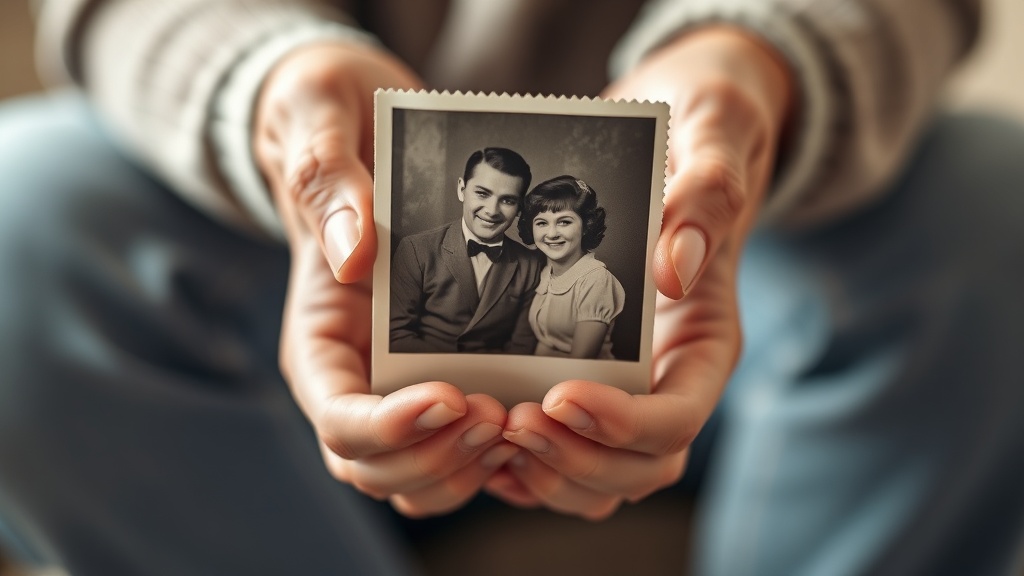
The best gift you’ll ever give your parents is already in a box in their closet.
It’s not wrapped. It’s not expensive. It’s a shoebox full of faded photographs—their wedding day, your first steps, that family vacation from 1994 where everyone looks sunburned and ridiculously happy.
Those photos are the raw material of the most powerful gift in the world. They just need transformation.
If you’ve ever struggled to find a meaningful gift for your parents’ anniversary, or a gift for someone who has everything, this article will change how you think about gift-giving entirely. Not with a sales pitch—but with science.
The Psychology of the Perfect Gift (It’s Not What You Think)
We spend billions of dollars every year trying to find “the perfect gift.” And we get it wrong most of the time.
Research from the Journal of Experimental Social Psychology consistently shows that experiential gifts create stronger emotional bonds than material ones. But here’s the nuance most gift guides miss: it’s not just experiences vs. objects. It’s about identity resonance—does the gift reflect who the person is, not just what they want?
Dr. Elizabeth Dunn, a professor of psychology at the University of British Columbia, has spent over a decade studying the relationship between spending and happiness. Her work demonstrates that the most satisfying gifts are those that show the giver truly knows the recipient. The dollar amount is nearly irrelevant.
For parents—especially those who’ve been married for decades—their identity is deeply tied to three things:
- Their love story. How they met, what they built together, the arc of their shared life.
- Their role as parents. The family they raised, the sacrifices they made, the moments they’re proud of.
- Their continuity across time. Evidence that their life has mattered, that the thread connects past to present.
A gift that touches all three of these identity pillars will outperform any luxury item, any gadget, any gift card. Every time.
Why Old Photos Have Extraordinary Emotional Power
Here’s a question: Why do people grab their photo albums when their house is on fire?
It’s not rational behavior. Those photos have no monetary value. But neurologically, they’re priceless.
The Neuroscience of Nostalgic Images
When we look at old photographs, our brains don’t simply “remember.” They reconstruct. The hippocampus fires up and begins reassembling the sensory details of the moment: the smell of the kitchen, the sound of laughter, the feeling of a child’s hand.
Dr. Constantine Sedikides, a social psychologist at the University of Southampton and one of the world’s leading researchers on nostalgia, has demonstrated that nostalgic memories activated by photographs:
- Increase feelings of social connectedness (combating loneliness)
- Boost self-esteem and sense of meaning in life
- Create physiological warmth (study participants literally felt warmer)
- Strengthen optimism about the future
In other words, looking at old family photos isn’t just pleasant—it’s therapeutic. And for aging parents, these benefits are especially significant.
The “Reminiscence Bump”
Psychologists have identified a phenomenon called the “reminiscence bump”—adults over 40 disproportionately recall memories from ages 15 to 30. This is exactly the period captured in most old family photos: courtship, weddings, early parenthood.
When you present your parents with a gift built from these photos, you’re not giving them something new. You’re activating the most emotionally charged period of their entire lives.
The Hidden Crisis: 43% of Families Are Procrastinating on Legacy
Here’s the uncomfortable truth.
According to Caring.com’s 2025 Estate Planning Study, 43% of Americans are procrastinating on essential family legacy tasks—organizing photos, recording stories, preserving memories. They know it matters. They intend to do it. They just… don’t.
The reasons are predictable:
- It feels overwhelming (“Where do I even start?”)
- It feels morbid (“We’ll get to it eventually”)
- It takes time nobody has (“Maybe next weekend”)
And so boxes of photographs sit in closets. Hard drives accumulate thousands of unsorted images. Family stories exist only in the minds of people who are getting older every day.
This isn’t just about organization. It’s about loss. Every year that passes, context fades. “Who is this woman in the blue dress?” becomes a question nobody can answer. The stories behind the photos—what happened that day, why everyone was laughing, who took the picture—vanish with the people who lived them.
The gap between “I should do something with these photos” and actually doing it is where a memory gift becomes transformative. Not because it organizes everything (it doesn’t have to), but because it transforms procrastination into celebration.
What Makes a “Memory Gift” Different From a Regular Gift
Let’s be specific about what we mean by a memory gift, because the term can sound vague.
A memory gift takes existing raw materials from someone’s life (photos, stories, objects, recordings) and transforms them into something new and emotionally resonant. The transformation is the gift—not the materials themselves.
Your parents already have the photos. What they don’t have is:
- A curated narrative. Their life story told back to them through the images they lived.
- Motion and music. The emotional amplification that comes from seeing a static photo come alive.
- A shared experience. Something the whole family can watch together and cry about (in the best way).
- Proof of attention. The unmistakable evidence that their child cared enough to go through those old photos and build something meaningful.
This is why a video made from their old photographs consistently ranks as the most emotional gift people report receiving. Not a new TV. Not a vacation. Not a luxury item. A video made from photos they already had.
The Science of Why Video Amplifies Photo Emotions
Static photos are powerful. But video transforms that power.
Movement Activates Mirror Neurons
When we see a person moving—even in an animated photograph—our mirror neuron system activates. We don’t just observe the movement; we feel it. A mother smiling in a still photo is beautiful. A mother smiling while turning her head, her eyes crinkling, in animated video? That triggers the sensation of being smiled at.
For parents watching an animated version of their wedding photo from 40 years ago, this neurological response can be overwhelming. They don’t just remember the moment. They re-experience it.
Music Triggers Autobiographical Memory
Add music to the equation and the emotional intensity multiplies. The psychology of music and memory is well-documented: familiar songs activate what researchers call “music-evoked autobiographical memories” (MEAMs)—involuntary, vivid, and highly emotional recollections triggered by specific songs.
When you pair your parents’ wedding photo with the song that played at their reception, you’re creating a multi-sensory memory trigger that’s almost impossible to resist emotionally.
The “Highlight Reel” Effect
Psychologists who study narrative identity have found that people construct their sense of self through key life scenes: high points, turning points, and early memories. A well-crafted video from old photos essentially constructs a “highlight reel” of your parents’ narrative identity—reflecting back to them the story of who they are.
This is why people cry when they watch these videos. They’re not just remembering events. They’re seeing their entire identity validated and celebrated.
How to Create a Memory Gift Video (Honest Guide)
You don’t need to be a filmmaker. You don’t need expensive software. Here’s a practical, no-nonsense guide.
Step 1: Gather the Photos
Time needed: 30-60 minutes
This is the most important step. You’re curating, not collecting.
The essential shots:
- Their wedding day (or early relationship)
- Pregnancy/early parenthood
- Family holidays and traditions
- Milestones: first home, graduations, births of grandchildren
- Candid moments—the unposed, imperfect ones are often the most powerful
- A recent photo to bring the story to present day
The “shoebox method”: If the photos are physical, don’t try to digitize everything. Pick 15-25 images that tell a story arc. Photograph them with your phone—most modern phones can capture surprisingly good scans.
Step 2: Choose Your Music
Time needed: 10 minutes
Music is 50% of the emotional impact. Choose songs that:
- Were popular during key eras of their life
- Were played at their wedding or other events
- They’ve mentioned loving or that remind you of them
Two songs is the sweet spot for a 3-5 minute video. More than that gets fragmented.
Step 3: Build the Video
Here you have several options, and I’ll be honest about each:
Option A: Revivaly (easiest, best for animated photos) Revivaly specializes in exactly this use case. Upload your photos, choose music, and the AI animates the faces and creates a cinematic video. The animation is what makes it special—seeing a static wedding photo come alive is the moment that makes parents gasp. Starting at $1 per photo.
Option B: iMovie or CapCut (free, more manual) If you prefer full creative control, these free editors let you arrange photos, add music, and create transitions manually. The result can be beautiful, but you’ll spend 2-4 hours learning the interface and fine-tuning timing. No photo animation.
Option C: Professional video editor (expensive, highest production value) Hiring a professional on Fiverr or Upwork costs $50-300+ and takes days to weeks. The quality can be outstanding, but the turnaround time makes this risky for a deadline.
Option D: Canva or Animoto (middle ground) Template-based video makers that are easier than full editors but less specialized than Revivaly. Good for basic slideshows, limited animation capabilities.
My honest recommendation: If your parents are the type to be moved by emotion, the photo animation is what separates a “nice slideshow” from a “moment they’ll never forget.” That’s Revivaly’s core strength. But any of these options is infinitely better than leaving the photos in the box.
Step 4: Add a Personal Touch
Before you present the video, write a short note—even just a few sentences:
“Mom and Dad, I went through the old photo boxes and realized your story is more beautiful than any movie I’ve ever seen. This is your life, told through the moments you gave us. Thank you for every single one.”
The note contextualizes the gift. It tells them this wasn’t a last-minute purchase. It was an act of love and attention.
The Gen Z Surprise: Young People Are Leading the Memory Movement
Here’s something that shocks most people.
Data from multiple 2025 surveys shows that adults aged 18-34 are MORE engaged with family legacy preservation than those aged 35-54. Read that again. The “TikTok generation” is more interested in preserving family memories than middle-aged adults.
Why?
The TikTok Effect
If you’ve been on TikTok in the past two years, you’ve seen the viral videos: a grandchild shows their grandparent an animated version of an old photo, and the reaction—shock, tears, trembling hands covering the mouth—has been viewed hundreds of millions of times.
These videos have done something remarkable. They’ve reframed family legacy preservation from a dusty, morbid chore into an emotionally compelling, shareable experience. Young people don’t see it as “estate planning.” They see it as content that happens to also be deeply meaningful.
Digital Natives, Analog Hearts
Gen Z grew up with smartphones, but they’re uniquely aware of the impermanence of digital life. They’ve watched platforms die (Vine, MySpace), seen photos lost to defunct cloud services, and experienced the anxiety of having thousands of images with no narrative.
This has created a paradox: the most digitally native generation is also the most motivated to preserve physical, analog memories. They want to take grandma’s shoeboxes and turn them into something that will survive the next platform collapse.
The Cremation Connection
This trend intersects with another cultural shift. According to the Cremation Association of North America (CANA) 2025 data, 61.8% of Americans now choose cremation—up from just 27% in 2000. As traditional burial (with its headstones, plots, and physical locations for memory) becomes less common, families are actively searching for new, more personal ways to honor and preserve memories of their loved ones.
Video memorials, animated photos, and digital legacy projects are filling this gap. The memory gift isn’t just a nice present—it’s part of a broader cultural movement toward more personalized, meaningful remembrance.
Interactive: What Kind of Memory Gift Creator Are You?
Before you dive into creating a memory gift, it helps to know your style. Answer these questions honestly:
Question 1: How much time can you realistically dedicate?
- A) 15-30 minutes—I need something quick but meaningful
- B) 1-2 hours—I can set aside an afternoon
- C) A full weekend—I want to go deep
Question 2: What’s your comfort level with technology?
- A) Basic—I can upload photos and click buttons
- B) Moderate—I can learn a new app fairly quickly
- C) Advanced—I’ve edited video before
Question 3: What matters most to you in the final product?
- A) The emotional reaction—I want tears
- B) The production quality—I want it to look professional
- C) The completeness—I want to include everything
Question 4: How will the gift be presented?
- A) Sent digitally (WhatsApp, email)
- B) Shown at a gathering (anniversary party, family dinner)
- C) Given as part of a larger gift package
Your Results:
Mostly A’s — The “Heart Over Craft” Creator You prioritize emotional impact over technical perfection. Your best bet: use Revivaly or a similar AI tool to create an animated photo video in under 30 minutes. Pick 10-15 of the most emotional photos, choose a meaningful song, and let the technology do the heavy lifting. The reaction will be just as powerful as if you spent 10 hours editing.
Mostly B’s — The “Balanced Storyteller” You want something that’s both moving and polished. Consider combining a Revivaly animated video with a handwritten letter or a small printed photo book. Spend an hour curating and another hour on presentation. The combination of digital and physical creates a multi-layered experience.
Mostly C’s — The “Legacy Architect” You want to create something comprehensive and lasting. Start with the video, but also consider recording your parents telling their stories, organizing a family photo archive, and creating a physical keepsake. This is a project, not just a gift—and that’s beautiful. Use tools like Revivaly for the video component, StoryWorth for story recording, and a service like Chatbooks or Artifact Uprising for printed materials.
The Gift-Giving Checklist: From Shoebox to Standing Ovation
Use this checklist to ensure your memory gift hits every emotional note:
Phase 1: Gathering (1-3 days before)
- Locate the old photo boxes, albums, or hard drives
- Ask siblings or relatives if they have photos you haven’t seen
- Select 15-25 photos that span different life stages
- Identify 2-3 songs that are meaningful to your parents
Phase 2: Creation (day of)
- Digitize physical photos (phone camera works fine)
- Upload to your chosen platform
- Arrange in rough chronological order
- Preview and adjust—does the story flow?
- Watch the final version yourself first (you’ll want tissues)
Phase 3: Presentation
- Write a personal note explaining why you made this
- Choose the right moment (not rushed, not distracted)
- Have tissues available (seriously)
- Record their reaction if they’d be comfortable with it
- Share the video file so they can rewatch anytime
Phase 4: After
- Send the video to family members who weren’t present
- Consider making it an annual tradition with new photos
- Ask your parents about the stories behind photos you included—there’s always more to learn
Why This Gift Works for Every Occasion
This isn’t just an anniversary gift. The memory gift video works for:
- Parents’ anniversary (especially milestone years: 25th, 30th, 40th, 50th)
- Mother’s Day or Father’s Day (a gift that says “your role in my life matters”)
- Retirement (celebrating a life’s work alongside family moments)
- Milestone birthdays (60th, 70th, 80th—the reminiscence bump makes these especially powerful)
- Holidays (when the whole family is together to watch it)
- “Just because” (honestly, sometimes the most powerful time is when it’s unexpected)
And unlike most gifts, it actually solves a real problem. Remember that 43% procrastination statistic? Every photo you include in this gift is one less photo gathering dust in a box. You’re not just giving a present. You’re doing the thing everyone in the family knows should be done but nobody has started.
The Deeper Truth About Gift-Giving
Here’s what most gift guides won’t tell you, because it’s not commercially convenient:
The best gifts don’t come from stores. They come from attention.
Attention to what your parents actually value (not what ads tell you they should want). Attention to the materials that already exist in their lives. Attention to the stories behind the photographs, the songs that make them go quiet, the moments they describe over and over at family dinners.
A video made from their old photos works so well because it is, fundamentally, proof that you were paying attention to their life. And for parents who spend most of their time paying attention to everyone else’s needs, being seen—truly seen—is the rarest gift of all.
The best gift is already in a box in their closet.
Now you know what to do with it.
Ready to transform your parents’ old photos into a video that will move them to tears? Try Revivaly—upload their most treasured photographs, choose a meaningful song, and watch their memories come alive. Starting at $1 per photo.
Ready to bring your own memories to life?
Create a Video Now